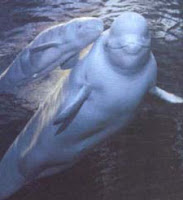
I call them the Mysteries of the Sea.. Sea Canaries, because of their Chirping voices, Yet their official name is Beluga Whale... Russian for White Whale. These gracious animals are whales of the far north. In Canada, the Arctic Variety inhabit rivers near Montreal Canada and their popu lation is more stable than their smaller cousin, the Cook Inlet Beluga Whale who inhabit the Coastal Inlet waters outside of Anchorage, Alaska.. Once hunted by Native Peopl
 es for their meat as well as their oil, Sustenance hunting was halted. At one time their population numbered in the thousands, today they are just slightly over 300. Back in 2007, NOAA issued a petition to get votes to place the imperiled Cook Inlet Beluga on the Endangered List. They received over 150,000 votes which was enough to have them placed on the list. Unfortunately the state overturned the vote, and the Belugas lost. Several months ago after intense effort and a lawsuit issued by several Environmental groups, The Belugas finally won what they rightfully deserved, and placed on the ESA. Then back in January Governor Sarah Palin, threaten to counter sue. Her idea to do oil and gas exploration in the Cook Inlet... Following no advice of the sound science and studies by experts, once again she attempted to side with the special interest groups and attempt to do great harm to an Endangered Species. I found this beautiful video which is breathtaking of these amazing beings. I hope and pray that humans step away from their arrogance in attempting to completely destroy this planet and begin to have some real sense.
http://www.youtube.com/watch?v=P4YdlTbtZA8
 Springtime for me is when everything comes into bloom. Deciduous trees come out of their winter's nap, Flowers start to bloom, Eagles Nesting and the other wonderful sounds of Nature coming alive. I love listening to all the amazing sounds in nature, and when you allow yourself to quiet your mind and slow down, it is amazing at what you can hear. For the last week on the Island spring has been an illusion. It plays spring one day, and then the next day it is winter again. Yet,
  the last couple of days; I am finally starting to believe that spring is here. The reason I know, is because I am sneezing more. I think it is the pine spores beginning to open that are making me sneeze. Yet I really do not mind, since I love spring in all its glory. For a small Island in the Pacific Northwest, I am amazed at the diversity of wildlife on the Island. I feel very blessed to come home, and hear Bald Eagles cackling away, and the honking of Canada Geese on their way home. Even noisy Stellar Jays make me smile. I have a new favorite shorebird, the Black Oyster catchers. These stylish clowns are very sensitive and like to nest on rocky shores and Islands without Trees. In the
  middle of Fisherman's Bay in Eastsound is a small Island that is affectionately called Indian Island. Named in honor of the Salish People who are the original inhabitants of the area. These birds are very sensitive, and because this island is so easily accessible by low tide, it is a concern that their nestin
 g will be interrupted. This summer myself and other San Juan County Beachwatchers are going to be part of a study monitoring the Island. I hope to educate others so that they learn to respect the wildlife out there. I have yet to see my first Hummingbird of the spring, yet I have heard rumors that they are buzzing about. Pretty soon the Swallows will return, and I adore watching them, fluttering about catching bugs and hopefully devouring every mosquito they can get their little beaks on. Some of the other wonderful Flighted friends I have seen lately are, Pileated Woodpeckers, a passing Migrating Rough Legged Hawk and quite a few Stellar Jays as well. I never tire of seeing Majestic Bald Eagles collecting their nest material and their love stories in the air. For me it is really an honor to be able to be so close to the diversity we have. This is why I want to do everything to protect our environment, so many generations to come, we can all still enjoy this abundance. We also have abundant Deer on the Island, and since they have no predators, they are starting to display patterns that show they are breeding themselves out. There are many Deer on this Island that have White patches all over them and are starting to look almost like fawns with spots spreading. I have heard this could be from inbreeding. In any case, I always love seeing their gentle and sweet eyes that are so endearing. Another favorite of mine are the River Otters. The River Otters here are Marine foraging river otters who spend a great deal of time in the sea. At first when I saw them, I mistook them for Sea Otters, which are slowly making a comeback to these inland waters, yet by no means common. I have often seen River Otters playing down by some of the beaches which is a joy to watch.. A few times I have mistaken their smaller cousins, the minks for one of them. Yet Minks are smaller and a deeper shade of brown. The Islands most favorite resident of course is the Orcas, or to some still Killer Whales. The name is to me a misnomer as back before they really knew about them, they were believed to be vicious killers for their predation on Marine Mammals. However over the course of the last 30 years, having been studied more, they have discovered that these highly intelligent creatures have very intricate family structures, and the term Killer Whale does not entirely fit them. In fact they are not even whales. They are the largest member of the Dolphin family. Biologists have now classified Orcas into three different sub cultures so to say. Residents, who live in large family groups and stay close together, primarily stay in the same areas most of the year. They are fish eaters, and their preferred dietary choice is Chinook Salmon. Unfortunately the Chinook stalks are endangered, and the food supply for the Orcas is very threatened. They have to travel further now for food, and this is causing them to use up to much energy to travel so far for food. Many of the studies are revealing that their thyroid hormone levels are severely compromised, and they are living off the fat which means essentially they are starving. Also too, their levels of PCB's and PBDE's are very high, which again compromising their immune systems. Males are more susceptible to this since they do not have anyway of releasing these toxins as the females who release by giving birth and passing it on to the newborn calves through their milk. Obviously this is not good either, as the Calves thus have a very high mortality rate, especially firstborns. Transient Orcas, the second type are Marine Mammal Eaters. They live in smaller pods, and their behavior is more unpredictable. They can change direciton at any time, and leave the general area. Another noteable difference is in size. Transients are larger, and have curved Dorsal fins, where as Residents are smaller and have straighter dorsal fins. The third type is the Offshores which are believed to be fish eaters as well, anything from Shark to even Octopus. They also travel in larger groups and live in the open ocean. Little is known about them, due to the fact they live further out at sea. The waters of the Salish Sea are also home to a Healthy population of harbor Seals, somewhere in the numbers of 6,000, also Harbor Porpoise which is less common, and they are very shy and Leary of boats, and then the Dalls Porpoise who resemble small Orcas with their striking Black and White Patterns. Dalls are really fun to watch. They love to Bow ride and sometimes will follow boats for hours. They are the fastest Cetacean on the planet, traveling at speeds up to 35mph. The Islands are a haven for many types of Seabirds, from Cormorants to Pigeon Guillemots with their bright red boots , Grebes, Rhino Aucklets, Murres and other wonderful members or the Alcid family of Birds, the closest thing we have to penguins. For me it is a true gift when you get to live in a place of incredible nature and beauty, and learn to share the magic of mother earth with all her children.

Monday and Tuesday, I attended the Transboundary Naturalist Conference in Port Townsend, focusing on our Resident Killer Whales ... I am still recovering from Information Overload, and attempting to compile the information I have learned from all the great speakers that were represented there. The Conference took place in Port Townsend on the Olympic Peninsula, and was held at Historic Fort Worden. I shared my journey there with the Crew and Owners of the M.V. Pacific Catalyst, a beautiful old Motor Cruiser that spends her summers cruising along Alaska's Inside Passage and conducting Eco-Tours of the Southeast...... Shannon and Bill, the proprietors were incredible hosts and more than gracious to four very lucky passengers. Three of us from Orcas Island, and one woman from Kirkland spent five wonderful hours on Sunday, enjoying relatively calm waters, sunshine and an array of abundant Seabirds. I like to refer to it as Bird Day afternoon. Mostly we saw Rhinoceros Aucklets, a beautiful member of the Alcid family group of Sea Birds which include, Puffins, Guillemots, Murres and more famously Penguins. We also viewed a rookery of Stellar Sea Lions, who are working there way back to their summer homes further north of here in Alaska and Canada.
Five hours later, we anchored in the harbor of Port Townsend and begin to get settled in for the evening prior to the start of the conference. Shannon had prepared a wonderful dinner of Enchiladas and Salad, and we proceeded pig out on the yummies. I drank a fair amount of Red wine, so later I had some heartburn and had trouble falling asleep. In any case, I am ever so grateful for our gracious hosts and the wonderful ride over to Port Townsend.
Monday morning we awoke and had a delicious breakfast of Eggs and bagels before the shuttle picked us up to head over to Fort Worden for the start of the conference. I was actually quite surprised at the huge turnout of Whale Watch Operators, Aquarium employees, Naturalists from both sides of the Border and many leading experts in the study of Whales. It was bound to be an information packed experience. I admit a great deal of the information I was already aware of, yet there were some additional information's that was very valuable and offered some conclusive facts to previous theories. I will add a few little tidbits at the end of the blog.
I was also impressed with the amazing meals that were included, along with our accommodations which proved to be an adventure in itself finding our rooms. For $75.00 we received dorm style accommodations for one night, lunch and dinner on Monday, Breakfast and lunch on Tuesday as well as snacks on our breaks. Amazing deal to me for everything we learned..
I also networked with some new folks as well as running into some fellow Naturalists that I already knew. Since I am still rather new to the field as well as the Islands, this was a an excellent experience for me. Although I have been a Naturalist and avid Nature lover for a very long time, these last two years I have gained so much from the Marine Naturalist Training I have done, as well as being a San Juan County Beachwatcher. I hope it starts to really pay off, and I can get out and share more of my passions as time goes on. It is a competitive field here, and there are just so many jobs to go around, so I hope to keep expanding on this.
After the first day was over, many of the attendees went into Port Townsend to enjoy the nightlife. I am not a huge socialite anymore, so even though it would of been good for me, I ended up kicking back and going to bed early.
Tuesday I awoke early to try an get online for a few minutes before the conference began. I really did not sleep all that much since it was fairly noisy in the dorms. Tuesday was also packed in with speakers, and later we found out the weather conditions were pretty rough, and since those of us who came over on boats, some had decided to try to head back early. Well, that changed quickly. The shuttle came to pick us up, and when we saw the white caps in the water, we all decided that it was better to wait until Wednesday morning to return, so we ended up going back to the conference to see the remaining speakers of the afternoon. When the conference concluded, we returned back to the dock and had a short meeting with Captain Bill to decide collectively if we wanted to stay another night or face the 12 foot swells and 30mph knots. We made the decision not to face the conditions, as some of the other boats went ahead anyway. As it turned out, we made the right decision. Apparently it was a very wild ride for them, and there was a great deal of sea sickness and upchucking their remains to the fish at hand. Boy, was I happy we did not attempt the conditions, and we were much better off leaving this morning, which turned out to be moderately calm and better conditions.
So, we made it back safely, although the wind kicked up when we started pulling into the harbor and slip which posed a challenge for the crew to tie up. All in all it was great, and I am so happy that a month ago I decided to attend.
A few worthy notes from the conference:
Over the past year they have been conducting Scat studies of the Residents utilizing Tucker, the scent Smelling dog. Tucker has been of great value to this study, and if it wasn't for the fact he really loves balls, the study might not have gone as well. At some point I will hopefully post a photo of this marvelous feat. According to previous theories and thoughts on the preferred food choice of the Resident Orcas, it has been concluded that 98.5 % of their diet is Chinook salmon, leaving 2% to other. This had been presumed, however thanks to this study ti is confirmed.
Another obvious conclusion that was pretty much known, is Northern Residents are less Toxic than Southern Residents..... which to me is pretty obvious with the Northern Residents being further away from Urban Centers as opposed to the Southern Residents.
J-pod has higher levels of PCB's and PBDE's which are more Prevalent in the Puget Sound/Georgia Basin Ecosystem.
K and L-pod have higher levels of DDt, which is linked to the fact they go south to California in the winter, and the Salmon from the San Joaquin and Sacramento Rivers are higher in DDT .
I will have more once I began to process all my notes and regain my Sea Legs back.

 lation is more stable than their smaller cousin, the Cook Inlet Beluga Whale who inhabit the Coastal Inlet waters outside of Anchorage, Alaska.. Once hunted by Native Peopl
 es for their meat as well as their oil, Sustenance hunting was halted. At one time their population numbered in the thousands, today they are just slightly over 300. Back in 2007, NOAA issued a petition to get votes to place the imperiled Cook Inlet Beluga on the Endangered List. They received over 150,000 votes which was enough to have them placed on the list. Unfortunately the state overturned the vote, and the Belugas lost. Several months ago after intense effort and a lawsuit issued by several Environmental groups, The Belugas finally won what they rightfully deserved, and placed on the ESA. Then back in January Governor Sarah Palin, threaten to counter sue. Her idea to do oil and gas exploration in the Cook Inlet... Following no advice of the sound science and studies by experts, once again she attempted to side with the special interest groups and attempt to do great harm to an Endangered Species. I found this beautiful video which is breathtaking of these amazing beings. I hope and pray that humans step away from their arrogance in attempting to completely destroy this planet and begin to have some real sense.


